

Transactional Email vs Marketing Email: What Actually Separates Them
· 5 min read
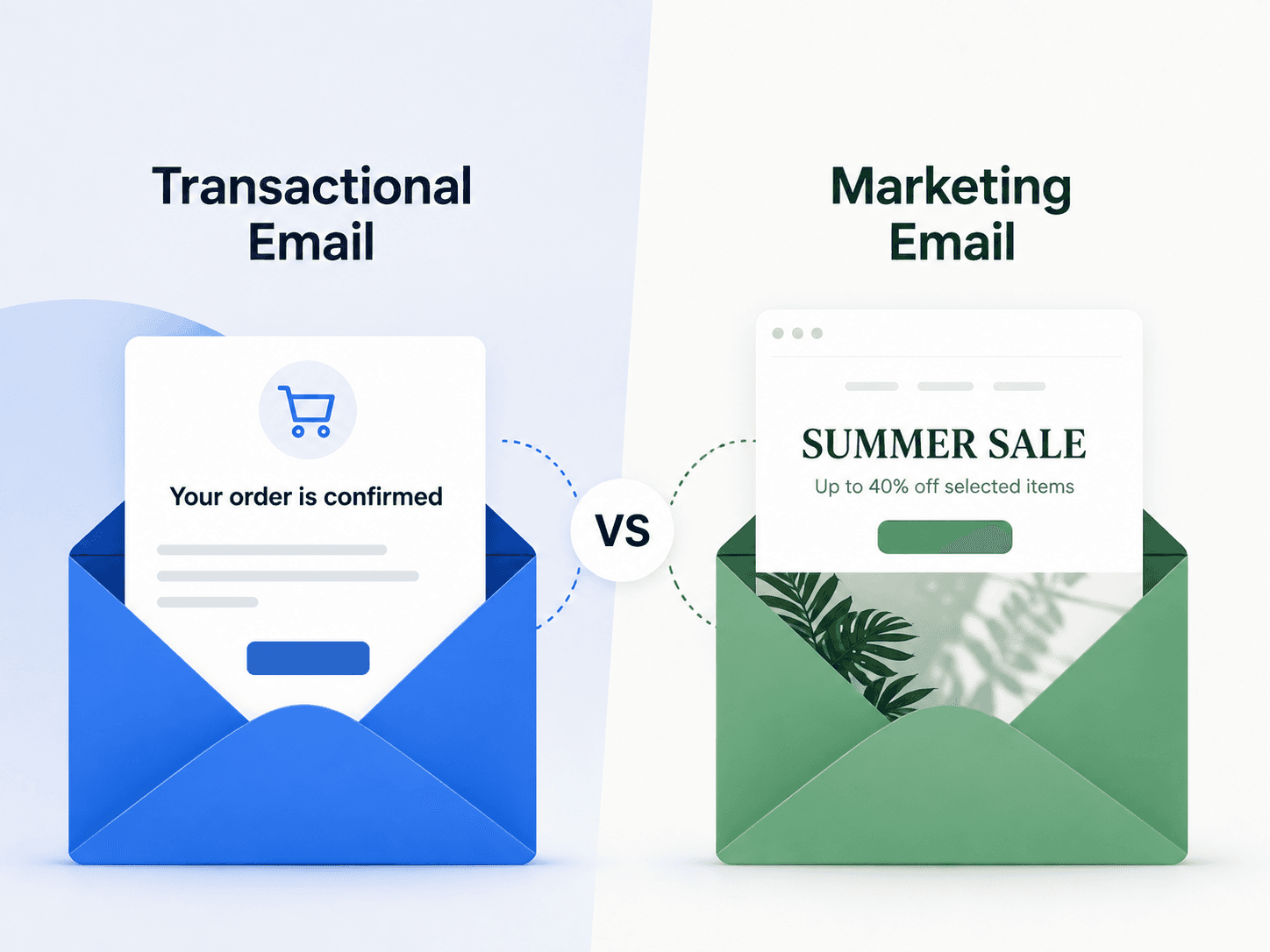
Most teams can define the difference in one sentence and still get it wrong in practice. The definition is easy. The consequences are where it gets expensive.
This guide covers what actually changes between the two — consent, infrastructure, reputation and legal exposure — and where the boundary blurs. For the broader concept, start with the transactional email guide.
The short version
A transactional email is triggered by a recipient's action and delivers information they need. A marketing email is initiated by you and promotes something.
| Transactional | Marketing | |
|---|---|---|
| Initiated by | The recipient, through an action | You, on a schedule |
| Purpose | Deliver required information | Promote or nurture |
| Recipients | One, with their own data | A segment or list |
| Consent | Contractual necessity | Explicit opt-in |
| Unsubscribe | Generally not required | Legally required |
| Volume pattern | Continuous, event-driven | Spiky, campaign-driven |
| Typical open rate | High — it is expected | Low — it interrupts |
That table is the part everyone knows. The rest of this article is the part that causes incidents.
Why the distinction has teeth
It determines your lawful basis
Marketing email needs consent. Transactional email generally does not, because the recipient triggered it and needs it to complete something they started.
Under GDPR, that usually means relying on contractual necessity rather than consent — you are sending the receipt because the person bought something, not because they agreed to hear from you. Under CAN-SPAM, the test is the message's primary purpose: if it is transactional or relationship content, the commercial-message obligations do not apply.
The practical consequence is that a user who unsubscribes from your marketing list must still receive their password reset. If your unsubscribe mechanism suppresses that address globally, you have built a way for users to lock themselves out of your product.
It determines your sender reputation
This one bites the hardest, and it is invisible until it isn't.
Mailbox providers score the reputation of your sending domain and IP based on engagement, complaints and bounces. Transactional email earns excellent signals — people open it, because they are waiting for it. Marketing email earns weaker ones by nature: lower opens, more complaints, more dead addresses.
Send both from the same domain and the averages merge. A single poorly targeted campaign that draws spam complaints degrades the reputation that your password resets depend on. The failure is silent — nothing errors, mail simply starts landing in spam.
The standard mitigation is subdomain separation:
mail.yourdomain.comfor transactionalnews.yourdomain.comfor marketing
Each accrues its own reputation. A bad campaign week can no longer take down account recovery. See the deliverability guide for how reputation is actually scored.
It determines your infrastructure
The two workloads are genuinely different engineering problems.
Transactional sending is latency-critical and low-volume-per-event: one message, right now, triggered by an API call, where a thirty-second delay is a product failure. Marketing sending is throughput-critical and bursty: a hundred thousand messages where nobody notices if delivery spreads over an hour.
That is why providers specialise, and why teams that try to run both through one pipeline end up with campaign sends queued ahead of password resets.
Keep transactional email on its own rails
Publish templates, send them by API from your backend, and keep every event-triggered email out of your marketing pipeline.
See how it worksWhere the line actually blurs
Almost nobody gets confused by a password reset. The arguments happen here.
Welcome emails
An email confirming an account was created, with a verification link, is transactional. An email welcoming someone to your product, built around feature promotion and a link to book a demo, is marketing. Same trigger, different primary purpose.
Receipts with recommendations
The receipt itself is transactional. Adding "customers also bought" shifts the balance, and if the promotional content dominates the message, the whole thing can be reclassified — bringing unsubscribe requirements with it.
A reasonable working rule: if you removed the promotional block, would the email still serve its purpose? If yes, you are probably fine. If the promotion is the email, it is marketing.
Re-engagement and expiry notices
"Your trial ends in three days" is transactional — it is information about an account state the user created. "We miss you, here's 20% off" is marketing, even though both are triggered automatically by the same inactivity.
Notification digests
A daily summary of activity in a user's account sits close to the line. It is triggered by their data and delivers information they asked for, but it is scheduled rather than event-driven. Most teams treat these as transactional but give them a preference toggle anyway — which is the sensible move whenever you are unsure.
The practical rule
When you cannot decide, ask two questions:
- Did the recipient's own action cause this specific message?
- Would they be worse off not receiving it?
Two yeses means transactional. Anything else, treat it as marketing and apply consent and unsubscribe. The cost of wrongly treating a marketing email as transactional is a regulatory problem and a spam complaint. The cost of wrongly treating a transactional email as marketing is a user who cannot log in.
What this means for how you build
The distinction stops being philosophical the moment you implement it:
- Separate suppression lists. A marketing unsubscribe must never block a transactional send.
- Separate sending domains. Isolate reputation before you need to, not after.
- Separate templates and ownership. Transactional templates change for correctness; marketing templates change for performance. Different review standards, different urgency.
- Separate monitoring. A drop in campaign opens is a marketing problem. A drop in password reset delivery is an incident.
Related reading
- Transactional Email: Definition, Examples & How It Works — the core guide
- Transactional Email Examples: 15 Real-World Types — what falls on the transactional side
- Transactional Email Best Practices — getting the execution right
- Transactional Email Deliverability — why reputation separation matters